
Don't Forget.
Introducing a new Strong Buzz restaurant column devoted to restaurants that are not new.

Friends.
There’s been a bit of talk lately about how food media is harming the restaurant industry – in our pursuit of covering openings, the next hot trend or the new chef du jour, we have left stalwart, steady neighborhood restaurants to wilt, wither, and die. “Success became defined by openings, buzz, and visibility instead of routine and reliance,” wrote Marco Shalma, Editor in Chief of the website “New York Eats Here,” in a piece titled “How Food Media Turned New York City into a City of Openings not Institutions.”
“This shift wasn’t accidental. Food media, platforms, and capital all rewarded novelty over durability. Restaurants learned quickly that being loud at opening mattered more than being essential six months later. The result is a city full of restaurants that are excellent at getting someone in once and terrible at giving them a reason to return.”
The post received a slew of comments in support of the sentiment that we in the food media are part of the problem, that we are starving local restaurants of customers by making only the shiny new restaurants relevant, shelving the neighborhood restaurants in favor of the hot flavor of the month. “New York does not need more openings,” he wrote. “It needs more places worth keeping. Restaurants people depend on. Restaurants that absorb bad weeks. Restaurants that become part of the city’s muscle memory. Until we stop rewarding attention over attachment, this cycle does not break. And the next round of closures will feel just as shocking, just as inevitable, and just as misunderstood as the last.”

Of course Mr. Shalma has a point. Media does cover what’s new; we are reporters that’s a big part of our role. But also, his position is rather naive – of course the media covers news and consumers want the latest and greatest. And yes, listicles and galleries of “Where to Eat Now” only reward the fresh faced newborns, not the wrinkled old timers. (Believe me, I’m a 56 year old woman, I get this.) But also, scoops drive clicks, openings bring eyeballs and subscribers. We have to make a living too. But as someone who has been in the media for 25 years, I can also confidently say that we cover innovation, creativity, collaborations, challenges, and victories. I guess I don’t feel like it’s that black and white, to paint the media as an enemy. But hey, I’m part of the media so I may be biased.
While I may feel Mr. Sharma is kind of pointing out the obvious, I do feel that he has a point. And it got me thinking that maybe I can do more to support our industry. Maybe I can use whatever platform I have to part the clouds hanging over our beloved older neighborhood restaurants, to let some sunshine in?
Which brings me to this, my first column under the umbrella I’m going to call Don’t Forget, coverage of restaurants that have been open for more than one year, places we should remember to support and visit and champion. (To give credit where credit is due, I’m borrowing the title of this column from Julie Besonen, my dear friend and former editor at Paper, a magazine I wrote for many years ago.)
If you like the idea or have a suggestion of a place I should cover for Don’t Forget, please message me!
And now let’s get right to it! Don’t Forget starts today, with a restaurant called Kinjo in DUMBO, a 13-seat omakase counter and cocktail lounge that feels like a well-kept secret tucked into a former torpedo factory under the M trains grumbling over the Manhattan Bridge in DUMBO at 11 Adams Street.
DON’T FORGET: KINJO


Kinjo - meaning “neighborhood” in Japanese - comes from longtime DUMBO residents Carley Roney (The Knot) and David Liu (XO Group, The Knot) and fellow entrepreneur and neighbor Dan Chiu (OS NYC & OS Studios). It may be hard to wrap your mind around an omakase restaurant being a neighborhood joint, but it’s more than just sushi, there’s a lounge, an izakaya too, so trust me here. It’s got a lot going for it. I think you will love it.
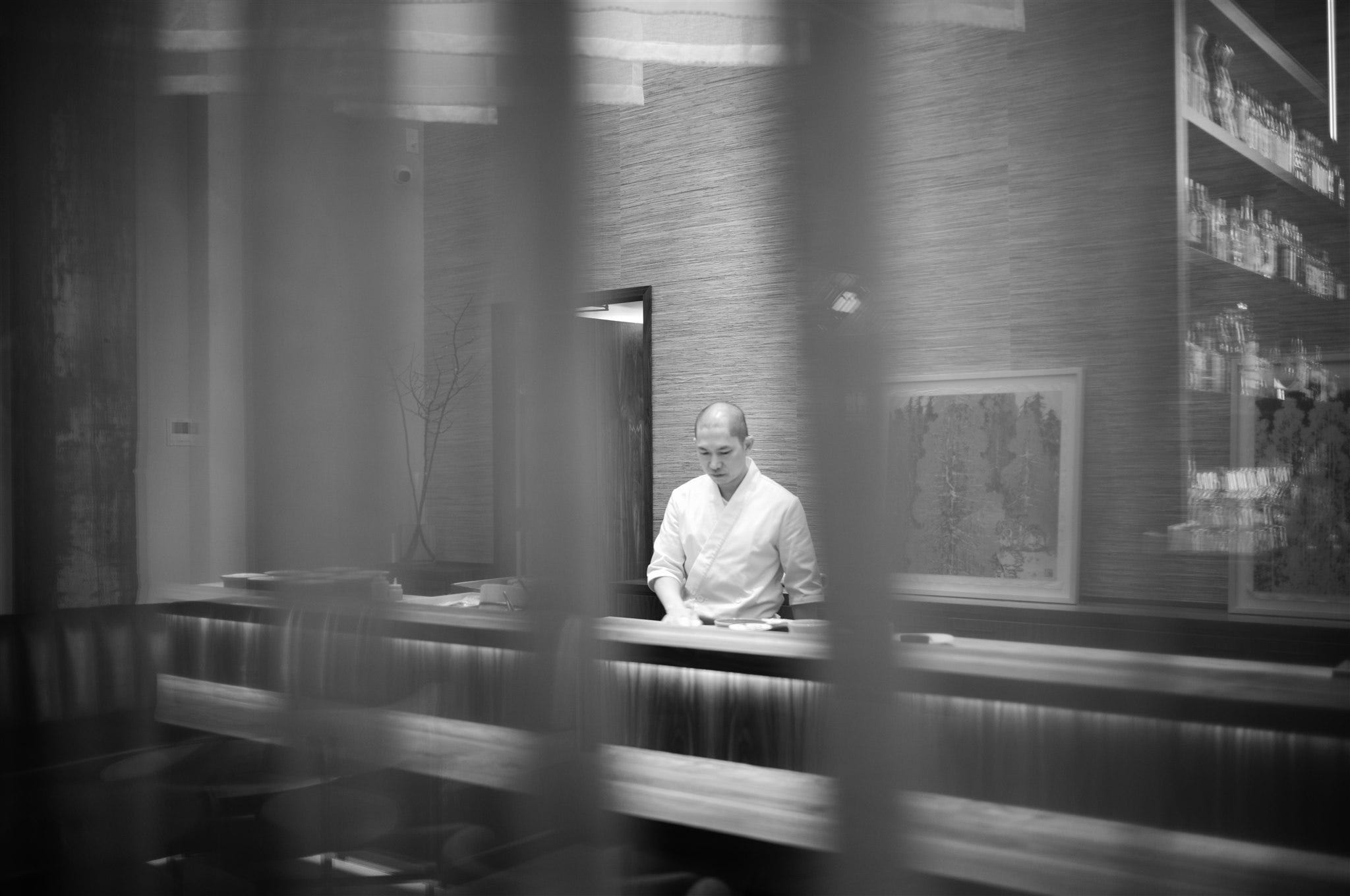
Let’s start with the omakase part of the concept. Behind a long walnut sushi counter, you’ll find Masa alum, chef and co-owner Johnny Huang, quietly and joyfully serving an amazing 11-course omakase menu that’s ridiculously reasonably priced at just $95 a person. Given the cost of dinner out these days, even just a burger or a roast chicken regularly clock in at over $30, and the double and triple Benjamin pricing of omakase in general, 11 courses for $95 is a bargain, the equivalent of a culinary sample sale.
The chef’s Winter Omakase builds in a progression of delights from light to heavy, beginning with a shallow ceramic bowl filled with two glossy scallops bobbing in a shallow puddle of ponzu, topped with a punch of briny uni and flecks of lava sat, the sort of opener that makes you never want to get to the closer.
On the night Eiji and I visited for dinner, the temps hovered around a balmy 13 degrees so the warm covered cup of chawanmushi felt like a warm hug, a steamy custard layered with sweet snow crab and earthy mushrooms then crowned with delicate bursts of caviar.
Next came a parade of luscious nigiri – a striped jack fish swiped with chive oil; the fish was what you expect, just gorgeous, but I was also struck by the rice; every grain its own island; rarely have I ever been so impressed with rice. Ginger and shiso adorn Aiori Ika, which was not for me; but maybe it’s for you – a cuttlefish, slick and chewy, texturally is something that doesn’t appeal to me. But that was the only dud and not for lack of beauty, just my own perhaps childish tastebuds.


A Shime Saba arrived next; a mackerel wrapped and cured, transformed by shiroita kombu, a white kelp, its flavor more assertive, a voice growing louder from the whisper of the scallop and striped jack. Otoro, buttery and blissful, came next, with a bit of fresh wasabi shoyu, a little masterpiece in one bite. Ditto the Kanpachi with yuzu pepper, and the Gindara, a silken sablefish swiped with a vinaigrette that leaned into the flavors of Korea with kimchee. Masunosuke, a rich and fatty King Salmon, gets brushed with a lemon miso and showered with a confetti of fried leeks, adding a citrusy high note and a nice contrasting texture with the leeks like potato chips. I’m not gonna lie; I kind of want everything to be brushed with lemon-miso and sprinkled with frizzled leeks.
Omakase at Kinjo ends traditionally with a soup – in this case, Kan Buri, a savory winter miso soup steeped with fatty yellowtail and root vegetables like daikon, carrot, and burdock. It’s the sort of broth that rights your world with every sip, resetting the janky bits that might be wonky or out of place. I’d have this every day if I could. The night ends with sweet soba pudding that tastes like a creme caramel, enough of a dessert to leave you feeling sated not stuffed.
The food, of course, is only part of the equation. The setting and the service are also magnificent. The sushi bar is slender and long and the room is lit with an amber glow, like a sun almost dipping down behind the horizon signaling the end of a beautiful day. The beverage program also impresses; Eiji did a very thoughtful non-alcoholic pairing and I did the sake pairing, which I highly recommend at $100, again seriously underpriced, with so many rare beautiful Junmai and Daiginjo bottles that are poured very generously. A favorite is a bottle that is brewed exclusively for Kinjo by locally-based Brooklyn Kura – a Junmai Gingo Namazake sake - crisp, light and aromatic with a dry finish.
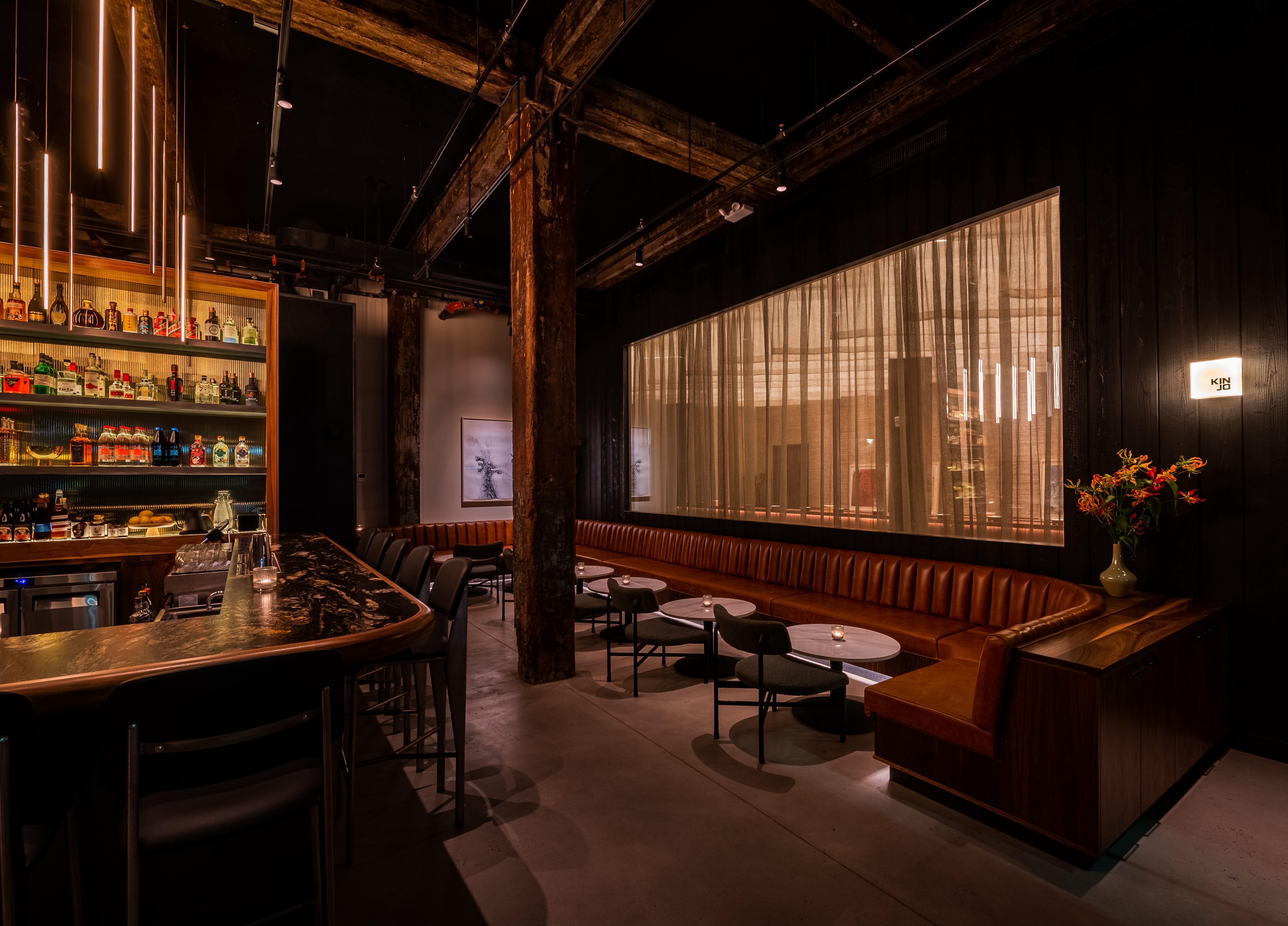
But there’s more to Kinjo than just omakase. A proscenium window draped in a gauzy curtain separates the white-coated chefs and the omakase diners from the stunning cocktail lounge next door. Designed in partnership with architects KIMOY Studios, the 15-seat stone cocktail bar and low-lit lounge is marked by century-worn wooden beams and exposed brick walls, but otherwise bears little resemblance to its former Torpedo factory.
The lounge has lots of seating beyond the bar, a sweeping banquette is dreamy and moody, and the space feels intimate and sumptuous, perfect for striping away the stresses of the day. Here you can tuck into serious cocktails crafted with Asian spirits–a yuzu negroni, a salty plum margarita, a shiso and peach highball, a miso espresso martini; you get the idea. While the chef doesn’t serve sushi in the lounge, he is doing an izakaya-inspired menu in collaboration with chef Eddie Lee (formerly of Momofuku)—donburi bowls, snow crab dip with kettle chips, morel yakisoba, a bavette steak, and yellowtail sashimi.
Kinjo is a little bit of magic secreted on a dark cobblestone street under the hulking Manhattan Bridge. The door is inconspicuous; you could miss it or wonder why it seems you are having dinner at the public library. It’s the unmarked door right next door. Open it and you’re through the wardrobe, stepping into Narnia. I hope you can make it and that you love it and if you do, tell your friends. Don’t forget.
Kinjo is located at 11 Adams Street.
Love, love, love this! Since we ONLY cover places that the locals have long ordained, you've got our attention. Beyondish has stayed out of NY/LA because we thought maybe we had nothing to add. You have me rethinking our position. Thank you!
“I guess I don’t feel like it’s that black and white, to paint the media as an enemy.” I liked (and commented on) the piece you mention and don’t think that’s what it was doing.